See how an AI companion can help you handle everyday problems, stay connected, and keep living on your own terms.

An AI companion helps you stay independent by handling the small problems that otherwise send you looking for help: a phone setting that changed, a blinking light on the furnace, a text that feels off, or a quiet afternoon with no one to talk to. You describe what is happening in your own words, and it talks you through the next step. It works best alongside family, friends, and your doctor.
What does staying independent mean?
For most people, independence is practical: living in your own home, running your own day, and making your own decisions. In AARP's 2024 Home and Community Preferences Survey, 75% of adults 50 and older said they want to stay in their current home as they age.
Independence rarely ends in one dramatic moment. More often, small things add up:
Tech that stops working. A TV stuck on a blue screen or a phone whose text suddenly shrinks can mean waiting for a relative or paying for a visit.
Quiet days. AARP's December 2025 research found that 35% of adults 60 and older are lonely.
Falls. The CDC reports that over 14 million adults 65 and older, about 1 in 4, fall each year.
Scams. One bad call can cost money and, just as important, your confidence.
An AI companion can't prevent a fall. What it can do is take the friction out of the small things, so you handle more on your own.
How can an AI companion help you stay independent?
Here are five everyday ways, with something you could say to get started. The examples are illustrative.
The pattern is the same each time: the companion explains, and you stay in charge. You press the buttons and make the decisions. If you use reminders for medications, confirm how they are delivered, and back up anything important with a pill organizer or a call from family.

What does a conversation look like?
Here is what a good companion does in three common situations. The examples are illustrative, and the details are invented.
A blinking light in the basement. “The furnace has a red light blinking. Should I be worried?” The companion asks what the display says, explains what that code usually means, and tells you whether it is a quick fix or time to call a technician. If you smell gas, it tells you to leave the house and call the gas company or 911.
A text that doesn't feel right. “A text says my bank account is frozen and I should click a link.” It explains the warning signs and suggests that you skip the link and call the bank on a number you already trust.
Something on your mind. “I can't decide whether to sell the house.” It helps you think out loud without taking sides, and suggests that you talk with family or an advisor before a big decision.
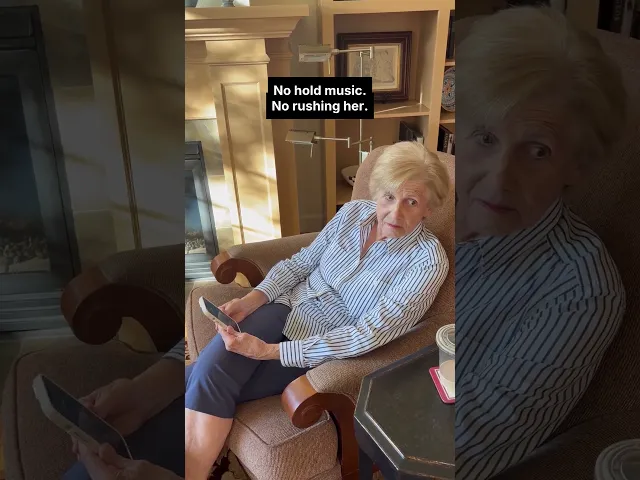
None of these needed a menu, a hold queue, or someone in a hurry.
Can an AI companion help with loneliness?
It can help, with limits. In the same AARP survey, 23% of lonely adults said they were interested in AI for companionship and conversation, compared with 15% of all adults 45 and older.
Early results from one program are encouraging. The New York State Office for the Aging placed an AI companion robot called ElliQ in more than 800 older adults' homes and reported a 95% reduction in loneliness. The announcement came from the state and the device's maker, and it doesn't explain how loneliness was measured, so treat it as a promising sign rather than proof.
The same AARP research has a caution: 24% of lonely adults say technology leads to fewer close friendships. Use a companion to fill quiet hours, and keep your calls and visits.
Do you need an app or a smartphone?
No. Many AI tools ask you to download an app, remember a password, and tap small icons. A phone-based companion asks you to do something you already know how to do: pick up the phone and talk. If you are new to AI, start with our plain-English guide, AI for Seniors, or read about AI companions for seniors that don't require an app.
A voice-only companion has limits. It can't see your screen or your furnace, so you describe what you see, and it can't tell if you have fallen.
What is Arthur?
Arthur is an AI companion you reach by calling or texting from any phone, including a landline. There is no app to download and nothing to set up. Some ways people talk to Arthur:
Tech help. Step-by-step directions for a phone, tablet, TV, or computer, at whatever pace you need.
A second opinion on scams. Describe a suspicious call, text, or email, and Arthur explains the warning signs and what to do next.
Conversation and check-ins. A friendly chat about your day, a hobby, or whatever is on your mind.
Arthur remembers earlier conversations, so you don't start from scratch each time. Like any AI, it can make mistakes, so check important health, money, or legal answers with someone you trust. Arthur is currently in beta.
See How Arthur Works
Watch a short call with Arthur, and find more on the Ask Arthur YouTube channel.
What should you know if you are helping a parent?
If you are an adult child, you may be the one who finds an AI companion first. How you introduce it matters:
Make it their choice. University of Houston researchers have found that many older adults worry AI could feel intrusive or like constant surveillance. Offer a companion as a tool for them, not a monitor for you.
Ask about privacy together. Find out what is recorded and who can see it, and tell your parent the answers.
Try the first call side by side. A first experience that works makes the second call easier.
Start with a real annoyance. A confusing remote or a suspicious text is a better first use than a demo.
Keep your own calls. The goal is fewer calls about the TV and more calls that are just a conversation.
What can't an AI companion do?
Knowing the limits is part of using one well.
It can't do physical tasks. It can't carry in groceries, change a light bulb, or help you bathe.
It can't handle emergencies. For a fall, chest pain, smoke, or a gas smell, call 911. AARP's 2024 survey found that 64% of adults 50 and older expect to need a medical alert system, and a companion does not replace one.
It can't replace your doctor, lawyer, or bank. Treat answers about health, money, and legal matters as a starting point and confirm them with a professional.
It can be wrong. AI can sound sure and still be mistaken, so double-check anything important.
For more safety rules, see AI for Seniors.
Frequently asked questions
Can an AI companion help me stay in my home longer?
It can take the friction out of everyday problems such as tech trouble, scams, and quiet days, which are common reasons people start to feel they need more help. It can't provide physical care, so it works best alongside family, caregivers, and, if you need one, a medical alert system.
Is an AI companion the same as Alexa or Siri?
No. Smart speakers mostly wait for short commands. An AI companion holds a longer conversation, follows along when you don't phrase things perfectly, and, in better versions, remembers you from one conversation to the next.
Will an AI companion replace my family?
It shouldn't. Some people worry that technology can crowd out real relationships, which is why family and friends should stay involved. Think of a companion as a way to fill quiet hours in between other calls and visits.
Is it safe to share personal information with an AI companion?
It depends on the company's privacy practices. Before you sign up, ask what is stored, who can see it, and whether conversations are used to train AI models. Keep bank details, passwords, and your Social Security number to yourself.
How do I know if I need more than an AI companion?
Repeated falls, missed medications, unpaid bills, getting lost, or changes in memory or mood are signs to talk with a doctor and arrange in-person support.
You can start with one call
You don't need to be good with technology. You only need a question. Arthur lets you call or text from the phone you already have, with no app to install. Try it, ask something small, and see what you think.
Sources linked in the article
AARP, 2024 Home and Community Preferences Survey: 75% of adults 50+ want to stay in their current home, and 64% expect to need a medical alert system.
AARP, December 2025 loneliness research: 35% of adults 60+ are lonely. Among lonely adults, 23% were interested in AI companionship and 24% said technology leads to fewer close friendships.
CDC, Older Adult Falls Data: over 14 million adults 65+ fall each year, about 1 in 4.
New York State Office for the Aging, ElliQ announcement: more than 800 older adults, with a reported 95% reduction in loneliness. The announcement doesn’t explain how loneliness was measured, and the article says so.
Techstrong.ai, “AI Helping Our Seniors Reengage”: University of Houston researchers on older adults’ surveillance worries. This reports the findings secondhand.
One simple plan. Everything Arthur does.
$35 a month for unlimited calls and texts. Try Arthur free for 14 days.
Start your free trial
No contract. Cancel anytime.