See how an AI companion can give you a second opinion on a suspicious call or text, before you click, pay, or share.

AI can help protect seniors from scams, but it is a second opinion, not a shield. A good AI companion can look at a suspicious text, call, or email, point out the warning signs, and slow you down before you click, pay, or share. It can also be wrong, and it can't stop a scammer from reaching you. It works best when you pair it with a few simple habits and the people you trust.
How big is the scam problem for older adults?
It is large and growing. In its 2025 Internet Crime Report, the FBI's Internet Crime Complaint Center counted 201,266 complaints from people 60 and older, with reported losses of about $7.7 billion. More than 12,000 of those victims lost over $100,000.
The Federal Trade Commission sees the same trend. It reports that fraud losses reported by adults 60 and older rose from about $600 million in 2020 to about $2.4 billion in 2024, roughly fourfold. These are reported losses, so the true total is likely higher.
The money is lost in a few familiar ways. In the FBI's 2025 data for people 60 and older, the largest losses came from:
Scam type | Reported losses, ages 60+ (2025) | How it often starts |
|---|---|---|
Investment scams | About $3.5 billion | A friendly stranger, an ad, or a message about a can't-miss opportunity |
Tech and customer support scams | About $1.0 billion | A pop-up or call claiming your computer or account has a problem |
Confidence and romance scams | About $584 million | An online relationship that leads to requests for money |
Phishing and spoofing, which means fake messages and calls that imitate a bank, store, or agency, produced the most complaints from older adults: 48,064.
Why are scams so hard to spot?
Scammers aren't careless. They create urgency, pose as people you trust, and make a request that sounds reasonable in the moment. A fake bank alert looks like a real one. A caller may know your name or your grandchild's name. Anyone can be fooled, especially when they are rushed, worried, or alone when the message arrives.
The most useful defense is a pause. A scam depends on you acting before you think, so anything that gives you a moment and a second opinion works against it.
How can an AI companion help you spot a scam?
Here are the ways a companion can help, with something you could say to get started. The examples are illustrative.

A companion can help with a text or email with a link, a call asking for money, a pop-up warning, an offer that sounds too good, and a message from ‘family’ asking for help.
The pattern is the same each time: you describe what happened, the companion explains what it sees, and you decide what to do. The most valuable part is often the pause itself.
What does a scam conversation look like?
Here is how a good companion handles two common situations. The examples are illustrative, and the details are invented.
The bank text. “A text says my account is frozen and I should click a link.” The companion points out the warning signs: a link in an unexpected message, a threat, and pressure to act now. It suggests that you skip the link and call your bank using the number on your card.
The urgent call. “A man says my grandson is in jail and needs bail money right now.” The companion tells you that urgency and secrecy are classic signs of a scam, and suggests that you hang up and call your grandson or another family member on a number you already trust.
In both cases the companion doesn't act for you. It helps you slow down and choose the safe next step.
How well does AI actually work for scam detection?
The honest answer is that it helps, but the evidence is still early, and AI isn't a guarantee.
One 2025 study, The Impact of LLM Assistance on User Spam Detection, tested what happens when people can ask a chatbot about suspicious emails. About 300 U.S. adults judged four emails, two spam and two legitimate. People with the chatbot were no more accurate overall than people without it, 70.8% against 72.5%. They also agreed with the chatbot 84.6% of the time, even when it was wrong. The chatbot had wrongly labeled one real Amazon email as phishing, and people with the chatbot were somewhat less likely to recognize it as legitimate, although that gap was not statistically significant.
The study has limits. It used an older chatbot model, the participants were more comfortable with technology than the typical U.S. adult, and it tested emails, not phone calls. Its lesson still applies: an AI that sounds confident can lead you astray if you accept every answer without thinking. The researchers recommended using AI to supplement scam training, not replace it.
So the sensible way to use a companion is as a second opinion that explains why something looks suspicious, while you keep making the call. If it says something looks safe, that is not proof. If it says something looks risky, treat that as a reason to stop and verify.
What can't an AI companion do against scams?
Knowing the limits is part of staying safe.
It can't stop a scammer from contacting you. It helps after the message or call arrives.
It can't verify who is on the other end. It can explain warning signs, but only you can confirm a caller's identity by hanging up and calling a number you trust.
It can't see your screen or your phone. A voice-only companion relies on your description, so details matter.
It can't get your money back. If you've already paid or shared information, call your bank or card company right away and report the scam.
What is Arthur?
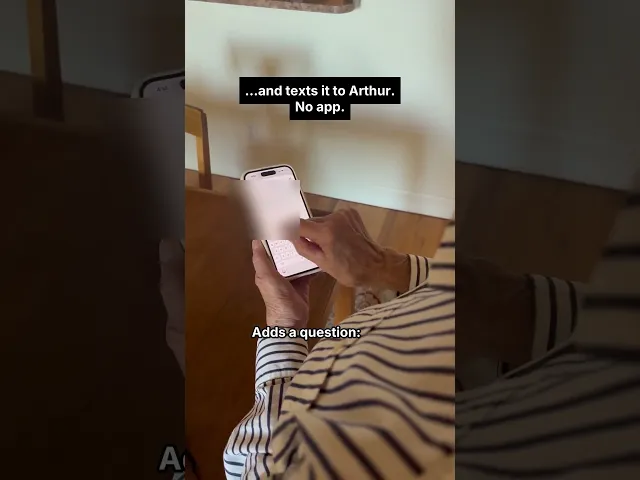
Arthur is an AI companion you reach by calling or texting from any phone, including a landline. There is no app to download and nothing to set up. One of the things people use Arthur for is a second opinion on scams: a calm place to describe a suspicious call, text, or email before you click, pay, or share, and understand what to do next. Arthur also helps with tech questions and everyday conversation, and it remembers earlier conversations. Like any AI, it can make mistakes, so check important health, money, or legal answers with someone you trust.
See How Arthur Works
Watch a short example of Arthur checking a suspicious message, and find more on the Ask Arthur YouTube channel. If you are new to AI, our plain-English guide, AI for Seniors, is a good place to start. Arthur can help you or your loved one with so many things.
Learn more about all the ways people use Arthur here.
What habits protect you best?
These habits work with or without AI, and a companion can remind you of them:
Pause. Urgency is the scammer's main tool. Take time before you respond to anything that demands action right now.
Don't click links in unexpected messages. Go to the company's website yourself, or call the number on your card or statement.
Hang up and call back. If a caller claims to be your bank, a government agency, or a relative, end the call and phone a number you already trust.
Never share passwords, codes, or your Social Security number with someone who contacted you first.
Be careful with unusual payments. Gift cards, wire transfers, and cryptocurrency are hard or impossible to reverse.
Tell someone. Scammers rely on secrecy. A quick call to a family member or friend breaks it.
What should you do if you think you've been scammed?
Act quickly, and don't be embarrassed. Scams happen to careful, smart people.
Contact your bank or card company right away to report the fraud and ask what can be done.
Report the scam to the FTC at ReportFraud.ftc.gov and, for online crimes, to the FBI at ic3.gov.
Call the free AARP Fraud Watch Network Helpline at 877-908-3360, open Monday through Friday, 8 a.m. to 8 p.m. ET.
If you feel in danger, or someone is threatening you, call 911.
How can you help a parent stay safe?
If you are an adult child, talk about scams before one happens, and make it a conversation, not a lecture. Agree on a family code word for emergency calls, remind your parent that you will never be upset if they ask about a suspicious message, and offer a companion as a tool for them to use, not a monitor for you. Ask about privacy together, and try the first call side by side.
Frequently asked questions
Can AI really tell if a message is a scam?
It can often point out common warning signs, but it can be wrong in both directions. Treat its answer as a second opinion and verify through a number or website you already trust.
Can an AI companion stop scam calls?
No. It can't block calls or stop a scammer from contacting you. It can help you decide what to do once a suspicious call, text, or email arrives.
Is it safe to tell an AI companion about a suspicious message?
Describing the message is fine. Don't read out passwords, bank details, or your Social Security number, to a companion or anyone else, and ask any company what it stores and who can see it.
What are the most common scams aimed at older adults?
Investment scams, tech and customer support scams, and romance scams caused the largest losses among people 60 and older in the FBI's 2025 data. Phishing and spoofing generated the most complaints.
What should I do if I already clicked a link or sent money?
Contact your bank or card company immediately, then report the scam to the FTC and the FBI. Acting quickly gives you the best chance of limiting the damage.
Do I need a smartphone to use an AI companion?
No. A phone-based companion such as Arthur works through an ordinary call or text from any phone, including a landline.
You can start with one call
The next time something feels off, you don't have to decide alone. Arthur lets you call or text from the phone you already have, with no app to install. Describe what happened, and take a moment before you click, pay, or share.
One simple plan. Everything Arthur does.
$35 a month for unlimited calls and texts. Try Arthur free for 14 days.
Start your free trial
No contract. Cancel anytime.